Page 5
WHAT'S NEW PART 1
PAGE 5
8th January 2011
It's bin a boring time on the cine front wot with visitors, trips away, a garage workshop cold enuff to freeze an Eskimo igloo and general disinclination,
no doubt due to gross culinary excesses. Done a bit of 17.5 checking - God that stuff can be filthy. Also checked 3 reels of 28mm, tho' why is less than
clear as none of them are mine. Pete G came over and we watched Metrollopis on 9.5, a really good print, too.
I have also had to deal with a severe attack of oldprojectoritis. One film I showed Pete was about the Great Eastern (Leviathan). Brunel has long
been one of my heroes, and his Dad was no slouch either, having virtually invented industrial mechanisation with his machinery to make wooden
pulley blocks for sailing ships. The film is obviously 60's, on Standard 8, and quite a scratched copy, but I've never come across another on any
format. Does anyone know anything? I showed it on a Eumig Mark S Std 8-only machine. I use this every few years, but it always needs a fair
bit of warming up, oiling etc before it's usable. The film is also 600', which is a squeeze on a 400' machine. I shall have to take Pete's advice,
and find a derelict machine so as to steal the (longer) front arm to replace the back arm of this machine.
When I was getting a projector ready for the 9.5 part of the show, I first tried my Specto 750 wot I converted to 9.5, but it has a 50mm lens and gives a minute pic. The problem here is that the 750 has this slightly bigger lens barrel - the standard Specto lens is 1" or 25.4mm in diameter, the 750 needs one 27.5mm diameter. This is too small to take obvious replacements like a sleeved-up B&H old series lens, cos there's just not enough thickness for a sleeve - B&H are 1" diameter like the standard Specto. I made a sleeve to fit the 750, wiv spiral grooves an' all, but I ent found a lens to suit. Any suggestions? I
remember this problem from years ago, when Chris Bird had a 9.5 750, even tho' they are not supposed to have been made. I had a hell of a job then
finding something that would do the job for him. Incidentally, the old Specto lenses can be pretty poor. I get a much sharper and brighter pic from
an 8mm zoom lens, but it has no grooves for focussing, which you therefore have to do by pulling it to and fro. This also pulls the zoom thingy, so it's
a bit of an art to ever get a film focussed and at the right size at the same time.
Anyway, I had to put the 750 to one side and try my 500. As soon as I turned it on, the lamp (an original 500w pre-focus) blew and blew the fuse as well.
I got the lamp out OK but could I get another in? I had to take off the side, and the side of the inner lamphouse, and have a go at the slots in the
lampholder for the lamp fins, which seemed to be far too tight, and then lever the lamp base in. I think the lampholder is one of the few poor features
of the Specto design. Anyway, the lamp sorted, the Specto then ran faultlessly for 5 reels of Metropolis and then a further 1000'. This was a compilation
reel, with the Pathescope Catalogue film introducing a range of silent material, but in this case padded out with additional footage from some of the
films, supplementing the fairly short extracts in the original Pathversion. It ends up with most of Billy the Ford Buster, and the last 100' or so ended
up wrapped around the spool spindle and/or on the floor. It was entirely my own fault - I had watched the film, not the projector, and I have always
known this film was too long - it almost overflows even its 1000' spool, which is virtually asking for trouble. I spose I shall have to trim something now.
With Pete's help, and many cries of "left hand down a bit" and "No, twist it the other way, you *****", we got it back on the spool.
16th December
Bonjour Messieurs (les Anglais peuvent s'en aller quelques instants). Je viens d'ajouter la page Langue Franise dails de mes films 17.5 Franis,
et aussi les projecteurs. S'il y on a lbas qui s'y intesse, rivez-moi. Je cherche en particulier du documents, catalogues, instructions etc sur 17.5 en France, par exemple les instructions pour le Super Rural et le Type 42 en 16, ou copies du journal "Cina partout et pour tous ". Les scans l'ordinateur
suffiront car c'est l'information plus que les documents eux-mes qui m'intessent. Je voudrais aussi les films muets.
15th December
During the cold weather, I have turned my mind once more to indoor activities like film checking. I have been doing some 17.5, and have been struck
once again by just how filthy the films on this gauge can be. If you got on the first pass with any other gauge what I am still getting on the third and
fourth pass, you would regard the film as filthy. ( on the other hand, I had a four reeler that was almost squeaky-clean) Hitherto, I have concentrated
on getting films repaired and projectable (I still have score of reels I've not even looked at - too readily deflected onto other things). However, a
while back I did a thorough clean of some silent film. It gave such a superb, almost luminous screen image on the screen that I am now doing more.
The difficulty with this is that it multiplies the amount of time spent per reel and cleaning stuff doesn't much agree with tape repairs or splices.
A problem I have found with most 17.5 is that it has always tended to look poor on screen, with all sorts of blotches and marks. I now suspect that
much of this is just muck - after all, 17.5 should give really good results.
The Super Rural amp I have been looking at has given further glimpses into the world of French 17.5, which was quite unlike the British scene.
Paul Schimmel says that the configuration of the Super Rural amp suggests an output of 25 watts, sufficient for a large hall. With a standard
110v 750w pre-focus lamp, this machine would have compared well with the 16mm machines of the day. Moreover, the amp is specifically
designed for two-machine, changeover operation as, indeed, is the standard Rural Sonore amp I have just acquired. If only we had had the
Rural Sonore here, how different things could have been. It was just a simple development of the tried and tested silent machine, with a
conventional layout rather then the weird design and film path of the Home Talkie/Natan 175. Presumably, Pathtook the view that the
English market would not be able to afford the undoubtedly more expensive Rural Sonore. One result has been damage to sprockets on a
large scale caused by unskilled users of the Home Talkie. Still, life is full of might-have-beens.
13th December
Not reported recently as garage too cold for work so little done.
Look at this email I received the other day (from Belgium).
"I would like to thank you because the information I found on your site decided me and helped me to repair an old Eumig Mark S projector coming from my father.
This machine remained (as many others I presume) for years unused until my wife asked me to review some movies from her young childhood.
I prepared all the needed stuff and we had a pleasant evening looking at old family stories but suddenly the projector stopped working.
After opening the rear cover of the machine, I discovered that the pivot of the motor was moving nearly freely in a kind of trapezoid hole.
Repairing this did not seem too complicated but it was clear that the same problem should affect the other pivot end which didnt seem very easy to reach.
You will not be surprised to hear that I did not find anybody willing to service such a vintage machine, so I started snuffing onto the web for a solution.
Finally I went on your site and saw that dismounting the machine was pretty easy after all and the pictures provided convinced me that you faced and solved exactly the same problem on the same model. So I did what you did; forced the old brass bushes into new shaped pieces of PVC and remounted the all thing which is now ready for another fifty years of pleasure.
Thanks a lot for sharing your experience and your knowledge!"
It is nice to be appreciated, just occasionally.
30th November
It has, of course, been too cold to spend much time in the workshop. I have done some more 9.5 film checking, a continually depressing job.
I have also been fiddling with my Bolex PA, which had been showing signs of ghosting. To get at the shutter to adjust it means removing the
lamphouse cover, the lamp fitting, the pulley and a. n. other assembly from the side, then removing the side cover. One can only realistically
test after pretty much completely reversing this process. Naturally, it took several attempts to get it right, a rather laborious process.
5th October
David Richardson has come up with some fascinating stuff on old Ensigns.


I also found this really weird little thing. It seems to be a film strip projector, not cine, with a record player.


Also these pix of the Dansonesque Movie Mite, plus another strange left hander, the Natco, both 16mm.


12 October
What have I been doing for it to be nearly a fortnight since the last entry?
I have:-
- finished a lamp conversion kit for an American friend's Lux, tested same and despatched
- checked a dozen reels of 9.5 and a couple of 16
- shown about a third of them
- in consequence of 2 above, invented an economy 9.5 tape splicer, as it's the only way to actually patch films up.
- discovered that my Lux lamp conversion only works if I cut about an eighth of an inch off the lamp pins. Either I used one of those low-voltage
lighting bulbs when I first did it, instead of a proper A1 bulb, or maybe I had a much thinner lampholder. I've also found that some of the low
voltage lampholder are now designed for the thicker pins many of the bulbs seem to have, and so won't fit proper projector lamps.
- cleaned up a Motocamera
- made a new spool retaining foldover thingy for a Rank Aldis (a Bauer P7 really) and
- dismantled the spool spindle entirely to fix the extreme stiffness that had caused the above to break as someone used it to
force the spindle round
- been to Rickmansworth
- tidied up various pix for this site and started going thru this page to ensure everything has been transferred to an appropriate page
- fiddled with a Coronet camera.
This latter has some points of interest. Apart from the usual cosmetics of scuffs, dints and shrunken leatherette peeling off, it had some more difficult problems. The mech was jammed and the winding key had been broken, probably two connected events. The former was easy to fix - I just poked a bit and something went SPOING! and then it worked OK. Ish, as you will see. A new key could be made, I guess. The next problem was the block which included one side of the gate, a housing for the barrel shutter and accommodated the rear of the lens. The block is made of Mazac and is distorting and cracking. A new one could be made, I think. However, altho' now running, the mech was hesitant and sometimes stuck, especially on starting but sometimes while running. The usual WD40, oil, cleaning up etc helped it to run smoother, but did not overcome this intermittent stiffness. As many will know, the Coronet is unusual in the narrow gauge field in having an intermittent sprocket instead of a claw. After much gazing into the innards, I felt the stiffness coincided with the parts of the Maltese Cross mech where the concave curve of the cross ran on the convex curve of the pin mech, ie between each movement of the intermittent sprocket. I had already begun to suspect that the Cross was made of Paxolin/fibre, as some projector gears are. It certainly has that look and feel, and I suppose it could have distorted just a fraction, enough to cause the problem. A new one of THOSE is not something that can realistically be made, so I have set the camera aside.
Does anyone know anything about the Coronet and its construction, or maybe have experience of a similar problem?
30th September
I thought I would just remind you of some of the things I am looking for.
A Pax 9.5 sound projector (preferably a French one, optical sound).
Any 17.5 equipment, films, catalogues and other literature.
Original or good copy of the following instructions, and magazines, catalogues etc to buy, copy or scan.
PathVox and Super Vox Instructions
Triplico projector Instructions (aka Peerless or Special Peerless)
Baby projector accessories leaflets
Instructions for any old or unusual projectors. Please do not chuck them out!
Issues of Cinema Chez Soi (The French equivalent of Pathescope Monthly) or Le Cina Partout et pour tous (a mag for 17.5 users in France).
Early Pathor Pathescope film catalogues and supplements in English or French.
Issues of Baby Cine Chat, a sort of precursor to Pathescope Monthly.
Not added a lot to the site lately cos of hols, then Harpenden where I had a stall and in a minute Rickmansworth. And 'er indoors is not well. Also,
am planning a trip to La Belle France to pick up certain projectors that have mysteriously become mine and are really too big for the post.
Also been doing some tidying of website, and have much more to do. There are all sorts of issues
-some pix won't show up on my master copy of the site as they are .BMP not .jpg. I have to find the originals and redo them.
-some older pix are not up to the standards I now have after learning more about photo editing.
-I keep adding new stuff like the projector index and contents list, which have to be regularly updated.
-I have been told that the layout gives people problems. I am working these days with a widescreen computer monitor, and recent stuff can be too wide
for those with "square" monitors. So I re-format when I do other things, and move pix away from the right of the screen, in the hope this will help.
-things have moved on and some of my older pages have been overtaken by new additions or just look old-fashioned to me. It was interesting to note at
Harpenden that a number of people used /viewed the site, tho' I never seem to get any communication from them.
-I keep coming across new material or stuff I haven't yet added. As you can see, I welcome input from other people, especially those with some
specialised knowledge that they are prepared to share.
19th August
Have found out an odd thing about a Bolex M8R. There is a capacitor in the base, part of the motor circuitry. Don't really understand what it does,
but the motor started surging to and fro in speed and tripping the power supply. Replaced the cap (which was labelled Hunts, apparently a notoriously
unreliable brand) and the motor was fine.
A friend has a Graflex 16mm sound with a motor that is also behaving badly. I seem to recall this was one of a number of look-alike machines sold
under various brand names such as Singer, Rank Aldis etc, tho' I may be wrong. Anyway, the motor runs, but only slowly and with no power, and it, too
trips the mains. The best guess so far is that the main winding has gone and it's turning over just on the capacitor circuit. Has anyone got a motor or a
non-working or incomplete (apart from the motor, of course) machine for spares that could be cannibalised?
13th August
 Mikael Barnard has been busy. First, he found me some old ebay pix of a Pathescope "H" with an add-on sound unit, a
thing of which I was not previously aware. After he first mentioned it, I did find a passing reference in an advert
(see 27th July entry below).
Then he found me an article by the late Alan Lott about Mazac. I have no publication reference, but assume it was ACE from the date of Nov 04 on
 the copy I have. In it, Alan likens our Mazac problems to those of model railway collectors, quoting a piece by Michael Foster in "Hornby Dublo Trains", one of the New Cavendish Hornby Companion series published some years ago. Basically, it seems to be all down to quality control. The basic mix is around 4% Aluminium, 0.04% Magnesium,, 1% Copper and the rest is Zinc. There are two factors which cause the problem: the Zinc must be of high purity, (99.9%) and any contamination of the mix must be avoided. From another source, Alan reported that "modern" standards (basically after WWII ) call for 99.99% pure zinc, with limits of 0.075% on Selenium, 0.0003% on lead, 0.0003% on Cadmium and 0.001% on Tin. These are fantastically tight limits, and it is easy to see how pre-war manufacture of toys and similar products might not have adhered rigorously to anything like such standards. Basically, if the mix was bad or contaminated, sooner or later the item will self-destruct, and nothing can be done to stop it. On the other hand, if all was well, there is no reason to expect any problem. We see this with PathBaby shutters - those on the earliest examples are usually fine.
Although Baby shutters are perhaps the best-known example of Mazac failure in our hobby, there are a number of others. The rewind handle for the old
KOK seems to have 100% mortality, the Lux suffers in terms of both its gate (early models) and motor end caps. The latter problem also afflicts motors on
the Vox/Super Vox and the silent 17.5 Rural. I have recently come across the problem in a Specto casting. New motor end caps can be made, but it's a tricky job unless you're really good at lathe work, especially with the Vox, where gears are mounted integrally with the cap.
30th July
Another illusion shattered. I got from Bob Andrews the other day a broken "shoe" that is the heart of the Siemens so-called Beta mechanism. Beater is the more usual term, I thought. Anyway, there was me thinking it was a triumph of German engineering 'cos no claw to damage film, but what do I find? A claw, that's what. I don't


see how you can call a thing with metal pins that go into the perforations anything but a claw; alright, it's a variant, but it's still a claw. And how does it achieve the boasted projection of damaged film? If the perf is missing or enlarged, the shoe will surely slide over the film and maybe cause damage. Here are the pix to show what I mean; a real 9.5/16 dual one (busted) and a pic from a contemporary ad. I shall send a copy of this to the guru of all things Siemens, Ron Ashton, to see if he can come up with a defence.
Dino Everett has provided what he thinks may show the last gasp of 9.5 in the US - looks like a fire sale. A sound-on-disc for $39.50! He reckons it dates to 1936 or 1937.

22nd July
Came across an interesting reference, in the same ACW for Dec 37, I think. It points out that, for a 200B using a blanking plate, a simple way to ensure the lamp is switched off during rewinding is to get a spare blanking plate and remove the centre pin, covering up with insulating tape. I never thought of that. Perhaps one could go further and make a new blanking plate substitute which would have a switch in it to connect or disconnect the lamp circuit...........
1st June
Been looking at http://users.telenet.be/frank.ttt/, which has pix of things I never knew of, eg a 16mm Noris like the 9.5 and 8mm ones, what looks like an American version of an H, very early Heurtier tri-gauge and a Bolex G3 rip-off. Loads of stuff also on phonographs, old radio's, film gauges etc. It's in Dutch, but I don't speak it and still found all them pix fascinating.
30th June
------------------------------------------------
20th June
Another old catlog from Dave Richardson. I doubt this one will surface soon - doing what you see here took hours.


7th June
Does anyone know if there is any difference between the 12v lamps sold for low-voltage lighting and the ones sold as Class A1 projection lamps? I suspect there could be differences in light output, life and filament position, but have no evidence or info.
2nd May
How can I not have looked at this site before? Lots of amazing stuff for the real techie on film, stocks, colour, Kinemacolor and other colour systems etc etc. Visit.
www.brianpritchard.com/Kinemacolor%20Project.htm
19th March
I recently worked on a 200B, recently acquired by its owner, that had gradually slowed down and ultimately ceased running almost completely. To cut a long story short, although the owner had oiled it, he had taken on board the injunctions one always sees in instructions not to over-oil. Unfortunately, he didn't have the instructions anyway, so had also missed some of the more carefully-hidden oiling holes beneath the lens and under the rear mech cover. Quite apart from the lack of instructions, a common problem with old projectors, this incident made me realise that you can't rely on "oil little and NOT often" guidance with a machine that's 50-plus years old and may not have been run at all in the last 20 years. What this machine needed was a good dosing with oil to ensure it reached all old, dried-out bearings etc - especially those on motors, where there is often a felt "wick" arrangement that has to be "re-filled" before any oil actually reaches the bearing. Then a good clean-up, after which one can revert to the standard advice and oil more sparingly. The machine then ran normally.
10th January 2010
Wot, you ask, hav he bin doin' all thru Xmas and well into New Year wiv no postings?
Well, partly it's been visitors - daughters, friends - and visiting - neighbours, friends. And partly it's been far too cold in my beloved workshop during this cold snap. And partly the excesses of Xmas and the darkness of the weather hav left me somnolent.
 One thing that actually took up a great deal of time was this, but at least it was something I could do largely inside, with just occasional forays into the garage. The back-story is that, some years ago, when I got back into 17.5 and 28mm, I identified the need for at least "fake" leader from 35mm, ie just a strip of film with no holes, to use on the front end of films where it would never need to go thru the projector, and saving the very limited supplies of real leader for where they were really needed. It was then I constructed the inner core of this device, the silvery drum buried in the middle. This drum is aluminium, with very narrow slots for cutters, so placed as to give 28mm wide with one blade and 17.5mm with two. Originally, I was using razor blades, then later I graduated to the circular blades you get in rotary cutters found in craft etc shops. Unfortunately, the original did not give very good results, the cut edges being very wavy and the width therefore a bit inconsistent. So I adopted a much lower-tech approach, and got some strips of steel cut to 28mm and 17.5 mm wide, then used a Stanley knife to cut. This was moderately successful.
However, I now have a need for something much more accurate. I have in recent times acquired quite a bit of 17.5 silent film, double-perf, and want to show it on the correct machine at something like the correct speed. I have zilch leader, however, of the double-perf persuasion. A year or two back, I acquired much of the 17.5 film and projector collection of John Cunningham, via another collector who had regretfully decided he couldn't keep it. Among this was a film perforator, John being a brilliant engineer. This, however, will only perforate one side at a time. It is also set for 17.25mm, on the assumption that 17.5 would have shrunk with time and the perforator really being meant to re-perforate film with chewed sprocket holes.
Clear so far?
So I decided to have another go at my first attempt, having concluded that the problem was the inherent jerkiness of hand operation and a lack of sufficient guides. Among many things I have acquired over the years is quite a bit of Meccano that is not good enough for my main model-making stock, but is fine for this sort of project. There is also the advantage that using Meccano in such poor condition means you escape the notice of the Meccano thought police who get very snippy about using non-Meccano parts. So I added chain drive for the cutters and the cutter drum, and various guides and braces and, after innumerable false starts, dismantlings and rebuildings arrived at the mech you see above. It does however, have two problems. First, it is an uncompromising engineering piece, with no thought for ease of setting up and using - it's a bugger to thread - and second, it doesn't actually work. The effort required to drive the cutters thru the film is quite high and I think it would probably need a much more robust mech to do the job. There may also be design flaws - after all, I just made it up as I went along. Still, I enjoyed the doing, even if it has proved fruitless. So I have retired to lick my wounds and ponder.
Another thing I have been doing is some adjustments to my second silent 17.5 Rural, once re-bodied as described on 24th December last. When I tested it, it wouldn't keep the bottom loop. This seemed likely to be due to the fact that the lower sprocket retaining thingy was not sprung, relying simply o n gravity. I couldn't see any simple way of adding a spring, but then I recalled that, when we had a conservatory built a year or two back, I had noticed lots of the lead flashing they used where the roof joined the house just lying about loose. I thought that as I was paying, I would keep a bit of this as you never know when it might come in useful. And so it has. I added three strips of lead (one is inside out of sight) held in place by one of those little devices where a screw fits into a threaded boss, with a countersunk head on both sides of the equation. This seems to have worked, tho' it will need a bit more testing to be certain.
The other problem was that I was getting a substantial halo of surplus light on the screen all round the picture. I have fitted a 15v 150w dichroic to this machine, rather than using the original Vox lamp. The other machine, with the original lamp, doesn't seem to have the same problem. I don't know if the  light is too bright, too unfocussed (I had to mount the dichroic pretty close to the gate), or if it is an artefact of a non-bloomed lens. Anyway, I thought of something that had puzzled me in one of the illustrations from a pre-war Alef catalogue (see Alef Mask). I thought, aha! Maybe this fitment is to block halos, so I made a thingy for the Rural. Unfortunately, it don't work - not having a lot of luck at the moment. I tried a bit of black card to reduce the size of the hole, but could not get a clean edge. I suspect this may be because my mask is before the point at which the light rays from the lens cross over - certainly, the bit of card had to go well into the hole before it was even noticeable. At least, that's a theory which I shall have to test. Anybody got a better idea?
24th December
I have been working away in my very cold garage on my second silent 17.5 Rural. You may recall (see 16th April entry below) that I was having problems finding a lens that would work. So far I have failed, but I was suddenly struck by what I can only describe as a brilliant idea, tho' I do say it myself. I have a couple of sound Rural-converted-to-16mm machines, pretty battered about. So I stripped down the mech of one of them, everything except the horizontal shaft which carries the cam and, crucially, the larger lens barrel that meant I couldn't use the lens in my silent mech. Then I put the silent mech parts in and Voil - I have a working silent Rural, with a lens, tho' it's a bit larger than the original. And I achieved all of this without making any permanent change to either machine. Cool, huh?
21st December
I have not been inactive, tho' it's a bit too cold in my garage right now for my liking. I have assisted a junior nerd to fit a tranny and 12v 10w lamp to a Baby, and fettled a motor to fit it. I have corrected two problems on Bolex DA so it now works; I am wondering about a) conversion to QI and b) fitting motor and lamp switches. I have checked and repaired some more 17.5 - a depressing occupation. I looked at Oliver Twist, 8r sound, on 4 x 1000' reels. Reels 1-3 sprockets almost totally intact (rare enough in itself). Reel 4 - water damage all the way thru, with frequent and regular quite small patches where the emulsion is dried out and scratchy or stripped off altogether. Looks like water fell onto the reel at one point and soaked in. Naturally, the worst affected is the sound track. Repaired a "test" film and ran it a) on Super Rural No. 1 and B) a Gebescope Model A converted to 17.5 by the late John Cunningham. He was a brilliant engineer and the Gebescope gives splendid results. Looked at a 16mm copy of Charlie the Burglar, which has nearly as much sprocket damage as a 9.5 or 17.5 film. I spose it mite just go thru a twin claw silent machine.
1st December
Found these as I was rummaging thru my computer files.

 Unfortunately, it seems that the present whereabouts of this historic copy of Napoleon are not known, even to Kevin Brownlow. It is sad, because I finally have the proper machine to show 17.5 silent, in the shape of an original Rural. My fear is it will get shown on a Home Talkie and damaged. I am just examining my copy of Betty's Good Fortune on 17.5 silent (the original title was Cinders). Almost every single sprocket hole down one side of Reels 1 & 2 is trashed, and there are numerous splices where material has obviously been lost. Even the other side has not escaped entirely, as someone has run it thru a Home Talkie reversed, projecting presumably via a mirror or prism Ironically, this probably makes the film unsuitable for a Rural, which only has one claw pin each side. What I really need is is a Rural Sonore, which would have a double claw on one side only and it would be possible to fit a slightly smaller motor pulley to reduce the speed to, say, 18 fps or whatever was deemed suitable. I can't change the speed on my Super Talkie; the only other option is the Home Talkie which caused the problem in the first place. That is not to say using a Home Talkie is impossible; I ran Christus successfully despite considerable sprocket damage, tho' nothing like as extensive as Cinders (I did run it in reverse with a mirror as the sprockets on that side seemed slightly better). The trick is to repair the film using tape so that it is completely free from un-repaired damage, and then watch it like a hawk thru the projector, especially that crucial top loop.
To return to Napoleon, it would be nice to know where it was, at least. Who knows - maybe the time has come to show it again? Tho' without the wonderful piano accompaniment of Arthur Dulay, 'twould be but a shadow of its former self. I seem to recall that the film has now been preserved on 35mm so, although some of the 17.5 material may have been used, it is no longer unique. Typical - narrow gauge film saves the day (as in Perils of Pauline on 28), then standard gauge comes along, copies it and thereafter takes all the credit. There ain't no justice.
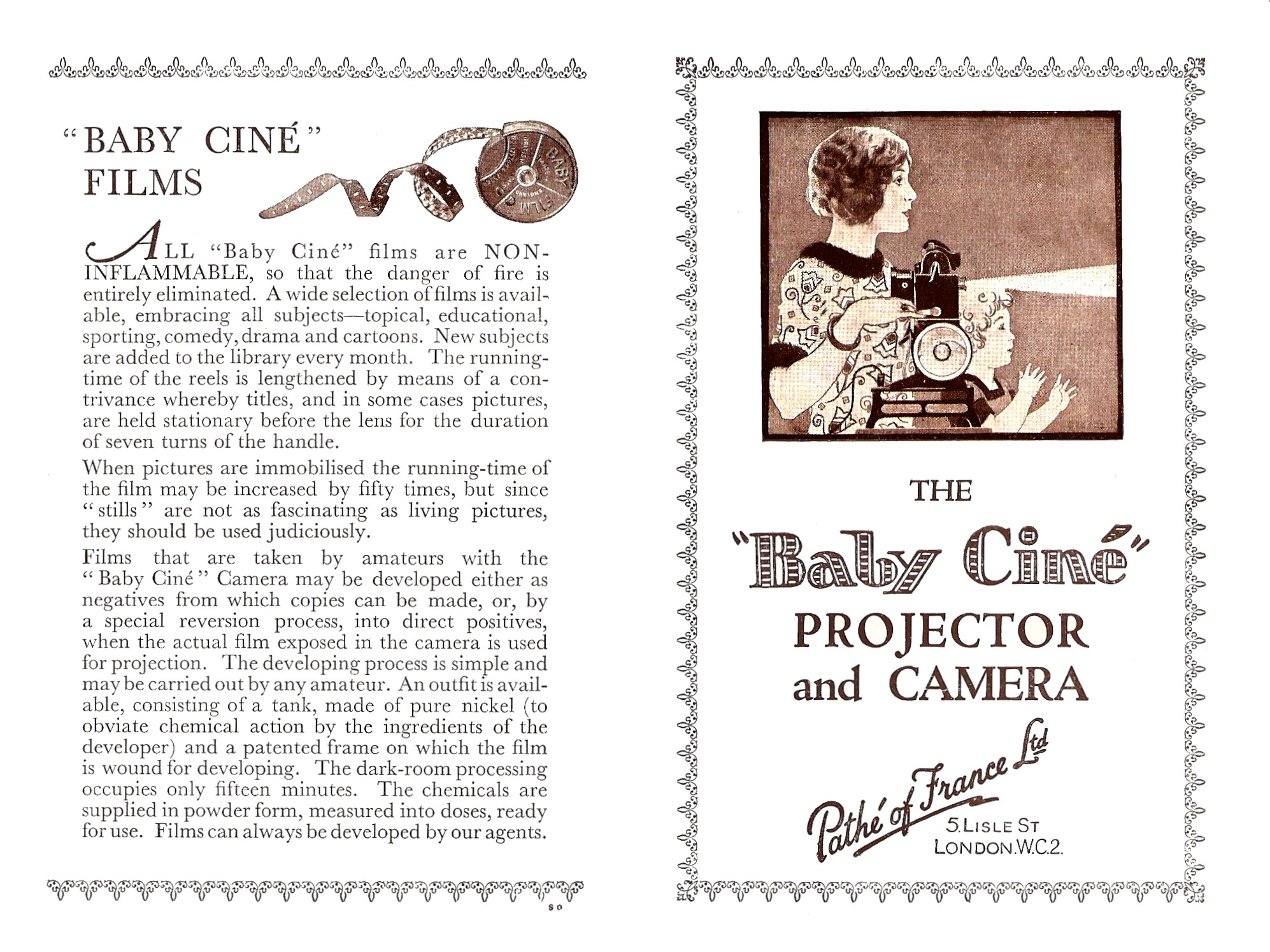
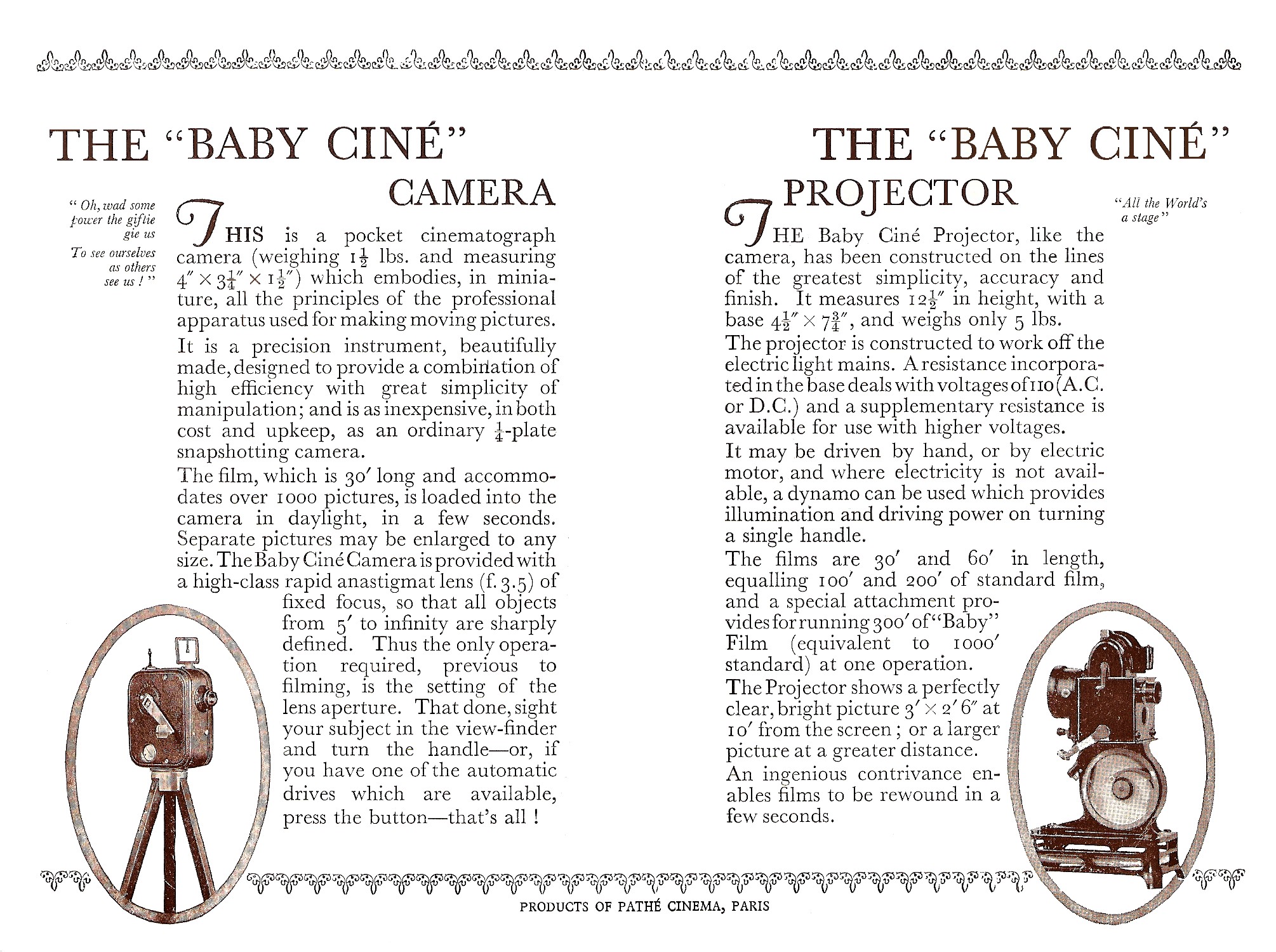 This Baby leaflet is also from Dave.
14th August
I've been adding some more to the Baby Film Catalogue section. I'm afraid the copies I have been able to borrow have been very poor, often photocopies to start with, and trying to get them halfway decent is a major effort. If anyone is able to lend or scan good originals, I would be grateful - any catalogues or supplements from the early days that are not already here, too, as well as Baby Cine Chat leaflets that came Before Pathescope Monthly.
Any good quality scans or loan copies of early or unusual literature are also welcome; you can see the sort of stuff, notably things like the Alef booklet (see 27th July below).
25th July
Been fiddling with a B&H 606H 8mm machine (July 2010). For some reason I have yet to discover, the motor is running slow and hot. Anyway, while I had it in bits, I thought you'd like to see the innards.


First pic is looking towards front of proj; top of proj is on R. Gate aperture bottom, that thingy top is the primitive speed control device. Second pic looks to rear of proj, which is upside down. The motor shaft (see pic 4) comes up thru that hole next to the pulley thing. The shaft carries a small grooved wheel, which is a friction drive against the larger one. Also evident is the still pic device, which opens a gap between the two wheels and brings the heat shutter into play.
The RH bit of pic 3 is the rear of the part in pic 2; you can see the bearing the motor shaft passes thru. The LH bit is a conventional motor cage. You can see upper R the curved slot into which fits a sliver of brake shoe material. Speed of the motor is controlled by this being forced against the face of the fan assembly on the motor shaft, ie control is by increasing or decreasing the load on the motor. I have always felt this to be poor design and a weak point of this B&H mechanism, although I suppose it doesn't matter much if you lose energy via a resistance or like this.
In the end, I failed to make the motor run fast all the time, so have shelved it as a spares machine. One other thing I did, tho', was to try a new way of wiring. The original B&H leads are rare and often decaying, so I removed the original fitting from the projector. In its place I put a block of steel, about a 1" cube (have to chamfer the corners a bit for it to go in). I made a threaded hole in it, so I could copy the original method of holding it in place, ie a screw down thru the top of the socket. I also bored a central hole for a wire, which was connected inside the machine by ordinary soldered joins, covered with heat-shrink tubing. I put a knot in the cable inside the machine to stop it being pulled about. As I also dislike those great, clumsy trailing leads, I cut the cable to about 6 " long and put a socket on the end, which will take any standard euro plug, like you get on kettles and computers.
Now that I have a way of by-passing the irritating B&H lead problem, I may use them more. The very short lead with a socket works for all sorts of machines, eg Elfs, whose long fixed leads are a pain.
10th July
I've decided I'm like a duck - sailing along all serene on the surface, but the little legs going like crazy out of sight. Have now added some more detailed manual/parts list stuff for the Victor.
Pour les Franis, je viens de traduire mon article en Flickers sur le 17,5 en Franis. Un ami est en train de le corriger, puis je le ferais disponible d'une manie dider.
In addition, have translated my latest 17.5 article in Flickers into French.
Have also played more with Super Rural. As reported on 2nd July, I was not satisfied with the lamp interlock arrangement. I have now sorted this, with much advice from Noel Pratt, by inserting a relay to control the lamp current. Basically, the motor switch is actually switching the mains supply to the motor tranny; once this switch is on, the tranny is fed and in turn feeds the motor. The switch also controls a mains feed to the relay; once the switch is on, the relay allows current to go to the lamp. If the relay is not receiving current, ie the motor switch is off, then the lamp gets no current. I did do a rough diagram which I shall try to include. The relay (Maplin) is a double pole double throw,  but I have wired it as SPST, wiring the pairs of contacts together, as shown, because it's a 10amp relay and 24v 250w is 10amp plus, tho' I doubt it matters at these low voltages. Pins 4 & 5 don't get used. The reason I have the lamp voltage thru the relay rather than controlling the mains input to the lamp tranny is that this is an Elf tranny and supplies the amp and exciter, too, and I wanted to be able to run the sound without the lamp.
In an attempt to deal with the distorted sound problem I hardly have to move the volume control from 0 to get sound too loud), I have added a potentiometer across the input to the amp, which I can adjust from outside via a small hole. Now working on the lamp, which I think is way out of alignment. I find along the way that the lens housing is the same size as Debrie lenses, but none of the short throw ones I have will go far enough back towards the gate to focus.
7th July
Terry Vacani has sent me this link - even if you can't do French, you should be able to find your way to some splendid pix of projectors etc. Path- Recherche simple
3rd July
Just found a new (mainly 16mm) website, www.paulivester.com. Inter alia, he has attempted a list of all Bell and Howell projector models.
2nd July
Been playing about with the Super Rural again (see May 2nd) and I think have got it working well. The problem is that the Elf amp inside the casing seems to give rather low and distorted sound, while an external amp gives excellent results. I suppose I shall have to go in and sort it, but it's a lot of fiddling as the main plate to which the amp components are attached has to be cut about to fit, and because of the way everything is wired together, I can only test a replacement amp once more or less fully installed.
When I first wired the machine up several years ago, the only way I could find to achieve a motor/lamp interlock was to make the motor switch control the mains input to the entire machine. So there was no amp until the motor was running, and I didn't really like that. After discussion with a friend, I tried again, wiring one wire of both the 110v for the motor and the 24v for the lamp thru the motor switch together, before going on to the motor and the lamp switch. This gave me interlock OK, but as I am usually good about switching motor off before lamp, I didn't find the problem at once. For reasons that I confess are not clear to me, I now have a 2-way switch sort of arrangement. If I switch on either the lamp OR the motor switch, the motor starts. If I then operate the other switch (either the motor or lamp, depending on which I pushed first), the lamp comes on. Switching off is the same; either switch will turn the lamp off, and the other then turns the motor off. Apart from anything else, this removes the option of one-switch emergency off, the second main point of having an interlock (the first of course being to stop the lamp being on without motor.) I shall have to think again.
I've also been making changes in my garage to create a bit more room and a bit less clutter, as I keep literally falling over stuff, and having to walk sideways- seriously! Together with this ghastly hot weather, which makes any serious activity impossible, not a lot has got done lately.
I'm sure I mentioned to you a while ago problems I had had with Elfs suddenly coming to a full stop, the cause being a take-up belt doing what I thought was impossible and wrapping itself around the lower pulley. I've been meaning to have  a go, and I just fitted a thing that may help - it's basically just a stripper. The tricky bit was fitting it without altering the projector, always an important consideration for me. Three screws hold a bit of 4mm brass rod to a thin steel plate. The lower screw for the arm's cover goes thru the hole you see, and the two screws near the top just keep the steel plate from pivoting, because of there being only a single fixing hole - they don't go into anything, they just locate the plate by being either side of the reinforcing rib. The cover goes back on top and you can't tell there's anything there. I've no idea if it will work; I'll get around to testing it one day.
10th May
Je me suis rendu compte que je m'occupe beaucoup des formats Path Franis. Alors, j'ai essayde traduire en Franis une de mes pages. J'espe que les amis Franis m'excuseront si je fait des erreurs, ou de langue ou de fait. Les remarques seraient bienvenues. Voir PathRural.
9th May


The silent Rural has only 500' spool arms - imagine showing eg Christus - (8 x 500'). If you should ever want to do such a thing, of course. So I am stealing the spool arms from several of my 16mm Rurals Sonores to provide "Super Arms". Nothing is ever easy, naturally. Pic one shows the ravages of Mazac on one of the take-up pulleys. The enclosure on top holds the brake mechanism, shown in exploded form alongside. As you can see, the wall of the enclosure is disintegrating and the pulley is warped a little out of shape. Pic 2 is my solution. I have sliced off the remains of the enclosure and fitted a new one, which has to have a rim to secure it to the pulley (with screws from the rear). I also skimmed the pulley to make it a bit neater. (The brass thing is just to hold it while I worked on it.) Finally, the spindle itself. The original 16mm one has just had the square part removed. What I then did, tho' I might not do it quite the same again (I was making it up as I went), was to turn the collar down a bit, then make a steel disc to go over it. I made the hole slightly small, then heated it and force-fitted it with a hammer. The problem is, the hole for the pin is about on the boundary of the two bits. It does work, but there has to be a better way. In this case, the pin is part screw-threaded and screws in from the back, where the screw-head is recessed.
30th April
Despite lack of reports, I have been working hard, first on my second 17.5 silent and then on trying to repair some of the ravages to my first Super Rural committed by a former owner. This is a continuation of work started before there even was a Cinerdistan! The silent machine is now a runner, with a rewound motor, a tranny (I chickened out of using the resistance and wired round it, fitting a separate lamp switch as per the first machine), and a 15v 150w dichroic mirror lamp. Mind you, I wonder if some projectors don't love me as they should - this one fought me every inch of the way. I made an improved barrel for the lens, dumping the copper tube. Then the lens stuck out the back and fouled the fan, so had to make and force fit a spacing washer at the end of the lens tube. Then the motor turned out to have been wound to turn the wrong way for this projector. Fortunately, I do know how to fix this. Typically for me, I haven't actually run any film yet.
The motor rewind was carried out for me by N J Motor Rewinders, 1587 London Rd, Leigh-on-sea, Essex SS9 2SG. Tel 01702 473 694. The price was about 50 excluding VAT and carriage, which I regard as exceptional value for such a specialised job. The fact that the motor turned the "wrong " way was because I never realised there was a choice and failed to specify.
I have closely examined the still picture mech on both silent machines, but I cannot see how it would work, at least with the machines as I got them. The shutter/heat filter inside the lamphouse is fine, but to achieve a still, the lever needs to push the main drive pulley away from the body of the machine, presumably against a spring, and disengaging some sort of clutch, so the motor can still run. Don't know how they would have dealt with the shutter on the occasions when it got in the way. Trouble is, at the moment, operating the lever causes the main drive shaft to jam as there is no movement available.
I have also been fettling up a Super Vox, not least by fitting a spare end cap to the motor, the original having Mazac'd. This is to replace on the standard Vox (see 28th Feb), which turned out to have an unstable pic, almost certainly due to grooves worn in the sides of the gate channel. Fixing this requires some very accurate machining out and fitting of new strips to forma clean edge. I bottled out, for the moment at least.