EUMIG 8
Eumig Mark S
An ad for the very first Mark S, sent in by John Fisher.

John has gently pointed out my relative lack of material on the Mark S, and has been rummaging in the archives. Here are some fruits of his research. Below is a full-page version of the first page of a two-part ACW Review of the Mark S when it was first introduced - a pretty momentous event in the home cine world.

The full ACW Report is in this PDF EumifMkSACW.pdf. No introduction of a new 8mm machine would, of course, be complete without the views of "Uncle" Ivan Watson - EumigMarkSIvan.pdf. For completeness, Mk_S709_Review.pdf is ACW reviewing a later version, basically the same machine with a few tweaks but with dual gauge capability. It was available in a Super 8-only version. I wonder if this is what I found in the piece below or if it was an earlier version.
Mark S Super 8
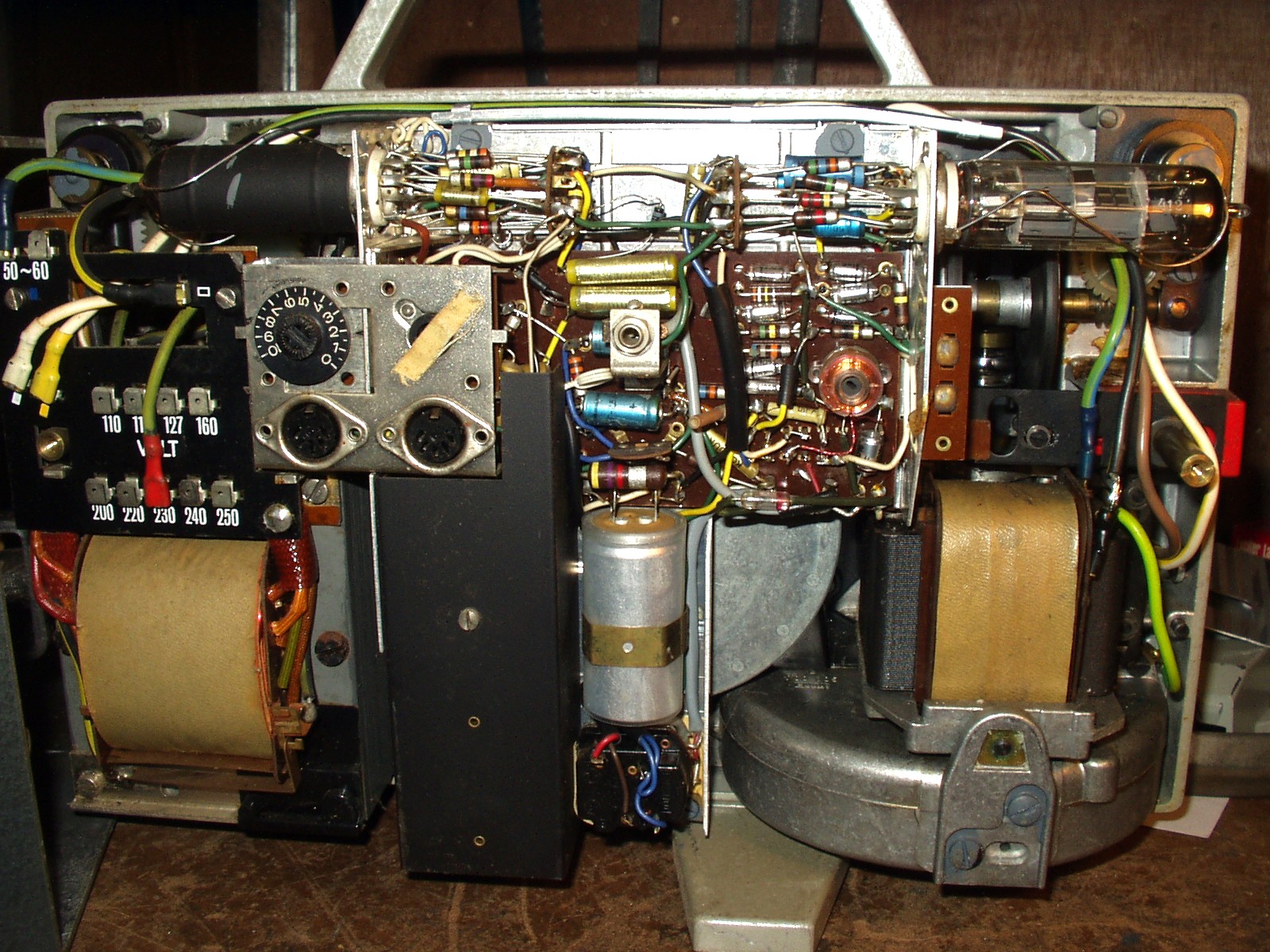
As part of a general inventorying of what I have, I came across a Mark S Super 8, still in its original cardboard box. As usual, it ran slow but I was able to improve this a bit. What I am snookered with is the amp, which delivers not a peep. Still, here are some pix of the amp from various angles.
Removing the amp is a relatively easy task. The first job is to unhook the three-pin and two-pin plugs alongside the sound heads. Then remove the on-off/volume control. Beware; there is a a metal ring round the shaft, which provides friction to hold the control in place. It may come off with the knob, which simply pulls off, so don't lose it. There is however a catch. There is a short lever part-way down the shaft which needs to be in a certain position before the amp can be removed. More of this anon.
The next step in liberating the amp is to remove the two screws securing the back cover. Then there are three screw sand some juggling with that lever on the volume control shaft and voila! A free amp! See pix below for more detail. (Note that the valves top left and bottom centre normally have a metal sleeve and the bottom valve and the circuitry immediately above are covered by a metal plate.)
Pic 1 shows the two plugs that need to be unhooked. In pic 2, I have marked with a red line as a pointer the three remaining screws that need to be femoved to free the amp. Remember that volume control shaft lever - you'll need to peer down the bottom of the amp (viewed from the back as in pic 2, near the marked screw) to see it. The other pix are just different views for illustration.


The Mark S is from the days when projectors were real projectors, made mostly of metal, weighing a ton and using valves in the amp.Even the relatively late model below was starting to go downhill I suspect, with plastic and transistors. These instructions - EumigMarkSInstrs.pdf -
are a bit more helpful than some, but still a long way from a repair/service manual

Interesting session with a Eumig Mark S. The problem being addressed was the motor mountings. In order to move to and fro to bring the drive shaft into contact with the rubber discs that take the drive, the motor has to pivot. The pivot supports seem to comprise some kind of plastic in the form of a trapezoid (if that is the correct name for a triangle wiv the top cut off) about 0.5" in most directions, with a brass bush inserted. The trapezoids fit into appropriately shaped recesses. The originals are apparently prone to disintegrate, and seemed to have done so in this case. Presumably, as Eumig went to the trouble of doing this, rather than just making holes in the supports themselves, they saw a need for insulation, so I used nylon, about 6mm thick, cut and filed to shape. Tho' it might have been springiness - the way the bits disintegrate reminds me of what happens with very old foam rubber/plastic eg as used to pack projector lamps. Here is a pic of a machine with intact thingies - look rather manky to me, altho these seem quite solid. You have to remove the amp and the fan housing to get at the corresponding thingy further inside the machine.
While the thing was partly broken down, I thought I might as well give you a couple of shots of the amp.

Returning to the pivots, I had to hand some brass tube with an i/d of 4mm (matching the motor pivots), which I force-fitted into a hole in the nylon. I wondered what people might be prepared to pay for a pair if they had this problem. I guess about £5 tops, which works out for me to a princely £2.50 per hour. So I'm unlikely to make any more. Typically, having done all this, I found some strange nylon triangles in an odd drawer of spares. I had not previously identified them, but guess what they were?
Here are some later models. The first, a Mark S 807D (for dual gauge), is clearly a successor to the Mark S, now much cherished by those still interested in Std 8 Sound. The second attempts to be both a small viewscreen and a projector, while the last seems to have descended to a mere generic clone.


 Eumig_Super_Instrs.pdf.
This is a Eumig Super. It was made in both 16mm and 9.5mm versions and, according to the Instructions, 8mm,too, although the one shown in the Instructions is 9.5mm. The 9.5 at least was known and badged in France at one time as the Pathé Rex. This was apparently because of anti-German and hence anti-Austrian sentiment before WWII. The full version of the Instructions is in the pdf.
Below is a Rex with the first page (but no more) of its French instructions, plus pix of two different types of gearbox apparently used in the Super range.


A very similar, yet still rather different machine, the P26, was produced for 8mm. The P26 (pic 1 below) had a much more attractive finish than the dull uniform black for the 9.5/16 versions, plus a few added controls and a weird approach to the lamphouse. The lamp resistance was placed directly above the lamp and, in the one I took apart, had burned quite badly as a result of its own heat combined with that of the lamp itself (pix 2 and 3 below). I rather like this one as it has all sorts of complicated twiddly bits - gorgeous. But I can't tell you if the version referred to in the Instructions above was just a Super or whether it meant one of these.

I still can't warm to the P8, although it is a machines produced in scores if not hundred of thousands.However, for those who can, here is a link to a website with lots of P8 info.
www.marriottworld.com/pieces/pieces25.htm
All I can give you is a couple of bits of P8 Instructions:-