Page 4
HomeContents 9.5 16 Multi-gauge 17.5 28 Pix Miscellany
WHAT'S NEW Page 4
13th June


This is my Fumeo 9139 Arc 300, originally fitted with a Marc lamp, now converted to 24v 250 B&H-style dichroic.
In this pic, it is without the hinged cover which conceals the mech and back of the lens.
The projector is basically brutalist in style, solid, chunky, heavy with no concessions to user-friendliness. It is a 16mm
body into which has been directly grafted an 8mm mech that is defiantly manual threading. It takes gigantic, specially-
made spools. The amp, on the other hand, is a flimsy construction, comprising a main board with the input/output
stuff but very few actual components. These are concentrated in four subsidiary boards which plug into the main board -
they are easily removable - with tiny little multi-way connectors. The amp is held into the machine by just two screws,
which leaves it free to flap about. The volume etc controls have no contact with the body of the projector and so have
a somewhat spongy feel. The selector switch for mag, optical (there is also a mag/opt slider control on the machine),
record etc feels quite positive, but just look at the construction!
Anyway, the amp don't work: as you know, I can't really do amps, certainly not solid state ones as complex as this, so I
now have to find someone to fix it. It strikes me that this would be an ideal machine to convert to one of those metal
halide lamps. Bill Parsons fitted one to a GS 1200 and it was way brighter than the Xenon one. However, it seems you
need a special one that will focus to cine sort of size, plus a power supply. I looked on the Wittner website; all up,
a conversion kit would cost 1000. Not today, thank you.
12th June
Dave Richardson found these pix in a cinema handbook dating to 1921. The case for the Premier is just like the one
I have, tho' I do not have the resistance.


10th June
Found a site (Chris Bird did, actually) which had info on a Pekoscope - http://www.retrothing.com/home_movies/.
The same site has a Lego projector........
5th June
I have finally gotten around to making a rewind of sufficient size to cope with the bigger reels, specifically the
super-extra-large Fumeo 8mm spools with those characteristic holes round the rim. It's not just a question of
vertical height of the arms - any spool on any gauge upwards of, say, 1200', starts to look daft or to be impractical
for checking and repair work unless the distance between the spools is sufficient. You also need a bit of depth
front-to-back of the base for greater stability. There seem to be a lot of rewinds about comprising a square
base, with a viewer set between two quite closely-spaced rewind arms, suitable only for really quite small spools.
I am, of course, limiting myself rather, as I have standardised on the Muray rewind arms, as I want and need to be
able to use them for as many gauges as possible, so the bigger 16mm jobbies are not really for me.
Those big Fumeo spools are really stretching Super 8 to the limits of the sensible. I have found that there is
potential for an awful lot of wobble in the variations between size of rewind spindle, bore of rewind adapter,
outer size of rewind adapter, bore of spool, width of spool and weight of spool. Then there is the depth of the
adapter and its various slots with yet more scope. So I ended up making special adapters, with tolerances
aimed specifically at the Fumeo spools. So they are a tight fit (too big for ordinary spools) and deeper than usual,
since yet another source of wobble is the outer edge of the spool bore losing support due to shortness of the adapter.
My new adapters are not perfect, but are a lot better than the ones I started with. Then I ran into the added
problem that, having raise the rewinds high enuff, the edge of the spool catches on the arm at the bottom. I
may have to fit rubber rollers.....
There are times when I find this sort of minutiae dispiriting. It all seems so trivial, yet unless one does it, it
just leads to problems.
It may be a small part of one of the more general problems of fiddling with projectors: Mission Creep.
You start out to do a specific job, but along the way many more aspects emerge and a simple one-hour job
turns out to take days.
28th May
Don't think I've shown you these before; dunno now where I got them. Likewise the Capitol. I do
not at all understand that business at the lower end.


27th May
New links for you, courtesy Dave Richardson. http://users.telenet.be/frank.ttt/ is in Dutch but has pretty pix; just
click on cine on the top bar and you then have a list on the left by gauge to click on. http://pierreg.free.fr/ is in
French, but with some translation into English and again has some good pix. In particular, it has a section on the
Mirage 9.5 projector which explains why it destroys film. See http://pierreg.free.fr/cine95/mater/projo/mirage.htm.
This is good 'cos I don't need to do it now.
Dave also sent pix of his even later version of the Baby from 1960. It even has provision for a cover, which the 1953
model does not seem to have - the last two pix are my 53 model.
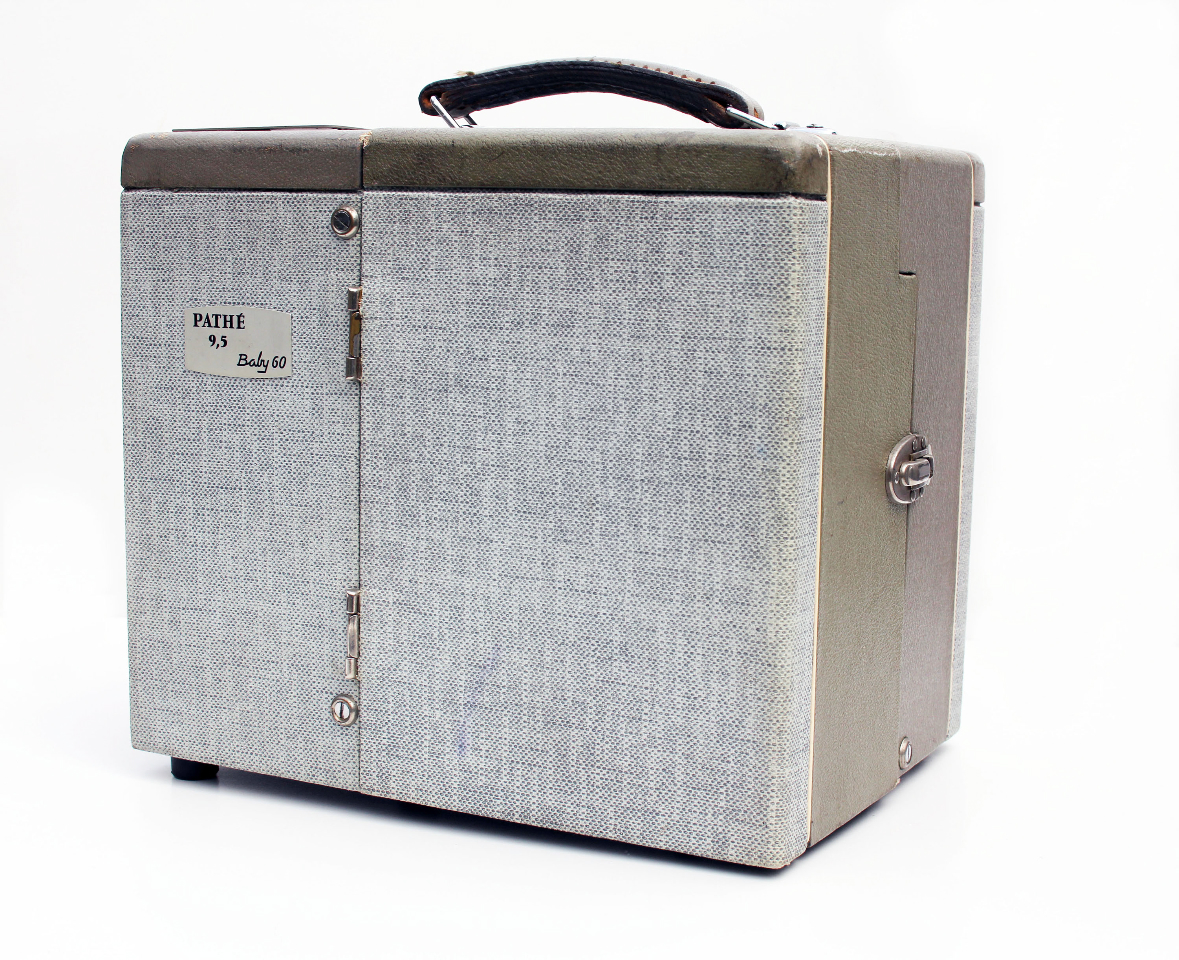


I am very much in two minds about this machine. On the one hand, it is very neat and compact, quite light and
cleverly designed. The way the arms fold cleanly away is nice, and there is a stud on the bottom to attach the
belt to when the arm is folded. I very much like the colour scheme of the 1960 version. But on the other hand, it
takes only 300/400 ft, the early one has a lens like a Son (ugh!) and everything has been pared down to a very
basic minimum- pressed steel for the arms, primitive bent metal for the spool dogs, no rewind apart from that
silly little thing that pops out on the take-up pulley, very basic arrangements to fit the back cover (little angle
brackets that are loose and hard to get the screw into contact with), a tinpot motor and a silly lamp - 125v 200w.
I don't think it reached this country in any great numbers, tho' some must have come - Dave's 1953 machine has a
big resistance built in to enable it to run on 240v, which is missing from mine.
And if you think you know a real loopy cinste, think again - he lives in France. Dino Everett found this
Krazy Kid on offer on eBay......


What can I say?
20th May
Dino Everett pointed me to a couple of things on eBay. First is this splendid 35mm jobbie, which apparently went for
just under $10,000. More pix here. Then there was this Baby in a Box which, altho' v. professional-looking,
does not seem to have been an official or commercial product, just the fruits of a someone deciding to do it and
do it well. More pix on the Baby page.

14th May
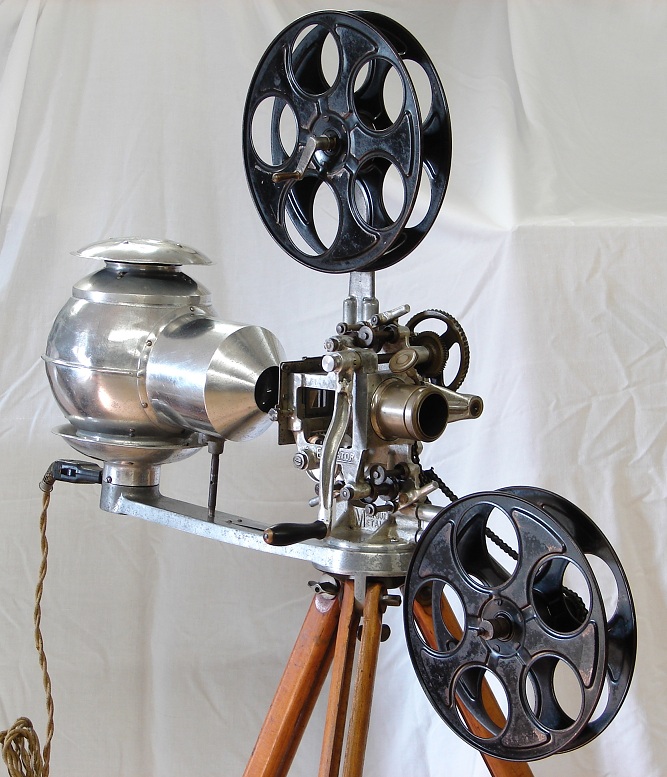
Just 'cos I have not been entering stuff here does not mean I have been totally idle. Spent a lot of time on a) a
Kodak Model B; b) looking at possible extension arms for the Ditmar; and c) finding out I have a Movilux Model 8 and
a Model 8b. I would like the instructions if anyone has them as there are bits I do not understand. Anyway, I haven't
really gotten to the point where I can tell you much about these things, but I will. Still got a lot to do on sorting out
post-building chaos.
30th April
Quite a bit of time recently on Ultra Pan 8, a widescreen film gauge, following a request from N. America to see if
a Specto could be converted to show this format. The results can be found at UP8.
19th April
I'm not the only one who looks abroad. Ian green sent in these pix.


16th April
Why is the UK branch of our hobby so dull compared with some, eg America and France? here are just a few shots I
culled from American ebay. OK, so I am sure the prices will be far higher than here, but did you ever see the like
of the Graphoscope in the first 6 pix? (NB 1st one might be stretched sideways). Or that gorgeous Kodascope
Model B in it's splendid case, in the last row of pix?


7th April
There are clearly highly skilled and determined people out there. Dominique Dalmar from France has sent me before
and after pix of a 28mm Pathescope Premier. What an amazing transformation!


Further to the Debrie pic below, Ken Finch has sent me some explanation.
"Having looked at your latest picture of the Debrie, it looks extremely similar to the old pre war PathDebrie. I had
one of these. It was my first 16mm machine and although it looked very similar to the later models there were a
number of mechanical differences. The intermittent although the same design was slightly simpler and only had a
The sound head gripped the edges of the film at the curved sound gate on top of the cell housing similar to the
17.5 mm machines. The film then went round the sound drum to the lower sprocket. There was no compensating
oller as on the later models or smoothing rollers before the sound gate. The base held a pre amplifier the bump
at the rear being a cover for 2 valves. The main amp was in a separate metal casing with one of those perforated
metal covers."
He also sent this snippet from ACW; the line drawing at the bottom makes the point re the sound set-up.

30th March
I thought this was a rather fine pic of a black Debrie. It is particularly interesting for having what looks like a curved
gate for the sound and very possibly no flywheel?

Ken Finch has referred me to Gerald McKee's projector book for the story on the Bolex DA and its shutter. I think I
have now got the story straight in my head. The original PA and DA did not have the rounded top and used an ordinary
2-blade shutter. The problem with this seems to have been flicker, tho' I must say it is not something I have noticed.
Bolex, however, introduced the 1937 Model, which had a larger diameter shutter, rotating much faster, giving three
obscurations per frame, so eliminating flicker. However, the faster shutter made more noise and, because it had a
big shutter with a single "hole" of about one quarter of the total, tended to stop with titles obscured, requiring
manual intervention. At the same time, a more powerful cooling fan was fitted, enabling a 400w lamp to replace the
earlier 250w. Naturally, people tended to use the 400w lamp in earlier models which didn't have the improved cooling,
hence the usual scorched lamphouse sported by most machines. Better than scorched titles, I suppose.
28th March
I always find looking at ebay for projectors etc depressing. Partly 'cos there's a load of dross - far too many slide projectors
and endless boring belts. Partly 'cos there are things I would quite like but cannot justify. But mostly because of the very silly
prices some people appear to be expecting for cine stuff. One of the joys of our hobby has been affordability, without the
dreaded "antique" label that always inflates prices, but this seems to be on the decline. It's not just stuff that remains unsold,
of which one never hears, of course, but even some sold items appear pricey - 190, was it, for a 400' capacity 9.5 Specto?
Madness.
5th March
Discovering interesting facts about the Bolex DA. I can now see there were (at least) two models, one
like the PA but the other with a large rounded protrusion on top. This appears to cater for a much larger
shutter. The only one I've seen is in this pic Dino sent me.

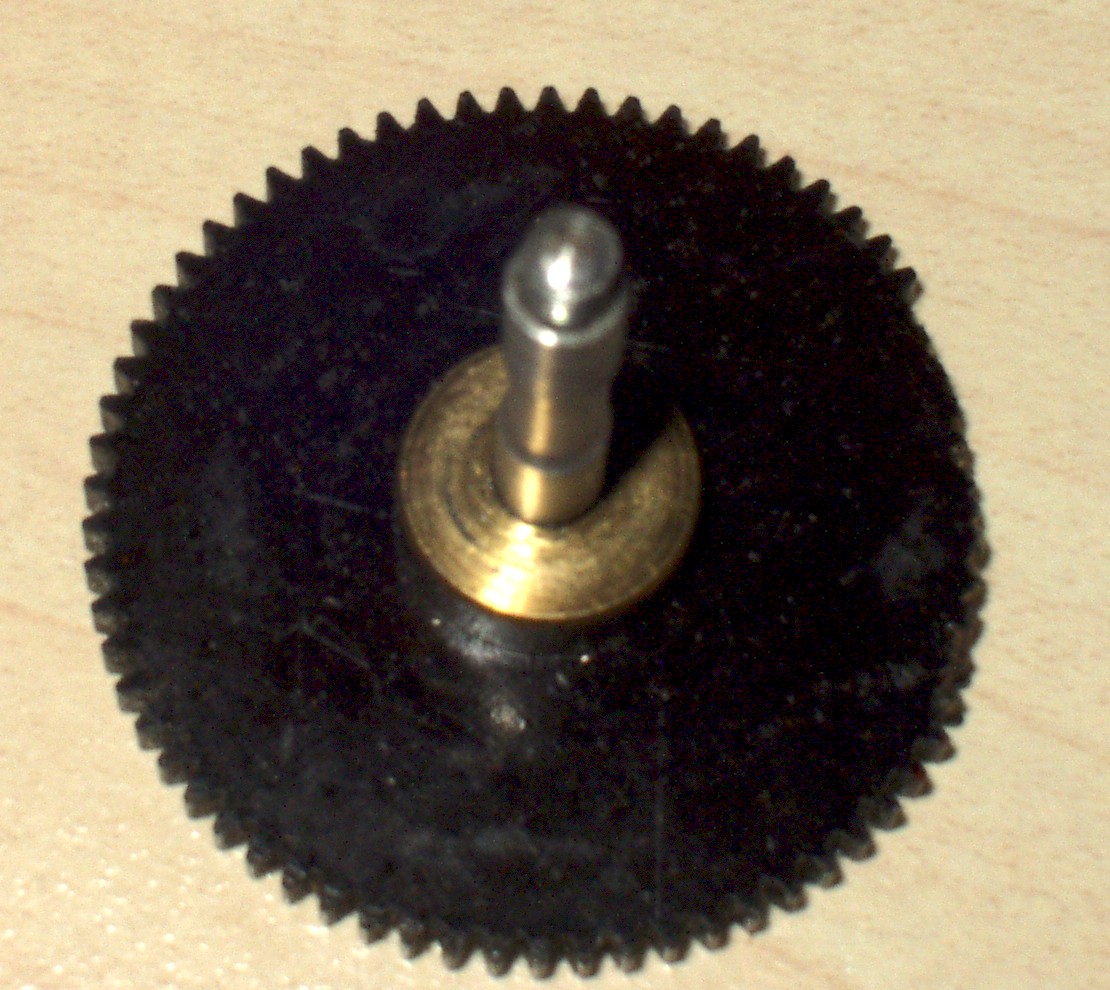
We got into this 'cos Dino's machine has stripped a fibre gear - see 2nd pic - and I am investigating the
possibility of having some made, in brass.
25th February
Nice to know there are still people out there who are even dafter than us! Dave Humphrey has drawn
my attention to 3 current items on ebay. A copy of Waiter for 425, reduced from 500, which I would
hesitate to accept as a gift. An early black Debrie, mistakenly labelled silent, maybe worth 25 as it's
early and assuming the motor is not buggered, offered for $1900. A 200B, which has a non-original base
and other mods, which is so described as to make it seem like a PathBaby, offered for $1500 and
worth maybe 35?. I do so hope the would-be sellers can't find anyone even dafter than them. This
sort of thing gives our hobby a bad name. It can only a) discourage those who might otherwise be
interested and b) give a completely false ideas of value to people who may think what they have,
or have inherited, is worth a small fortune, and don't understand that such prices are found only in
cloud cuckoo land.
18th January
I saw on ebay an offer of a DVD with scanned copies of 28mm projector handbooks. At 9.99, I was unable to
resist and got back an astonishing disc with what I think is a pretty pukka catalogue of this guy's collection. I
say think as I don't do Italian and he don't do much English, so communication is very basic. But this disc has
a huge range of images, of posters, of catalogues, of equipment, a lot about still cameras as well. I think
he may be willing to sell scanned copies of much of it. It is, of course, principally in Italian or French, tho'
there are a number of English-language adverts/manuals. But even for just the pix you see on this disc it is
well worth it. All I have is an email address, unfortunately. Here is a pic of the disc cover, you could just
email him a copy and ask for this. He does Paypal.

23rd December
I haven't bothered much with cine cameras, but I just happened to pick up from a friend's bookshelf The Collector's Guide
to Cine Cameras by John Wade. First published in 2001, it covers pretty much the whole field as we ever knew it in the UK;
not many new cameras introduced after that time. I actually found it quite interesting, so much so that I immediately
bought a copy for myself. It taught me things I didn't previously know, like the fact that there were "Single 8" Standard 8
cameras as well as the later Super 8-based Fuji system and that the famous Minox camera, used by spies in films, used 9.5mm
film. I did find some holes eg no reference to the Mk 2 Campro with proper aperture control, but I would think it is impossible
for one person to cover such a broad field and to expect perfection.
After all, Mr Wade published before there was a Cinerdistan to help him! (Not that he'd find much on cameras).
28th November
Rene Villareal has sent me some pix of film that appears to be something of an odd size.


Width is 14.5mm, sprocket holes seem to be the same as 16mm but seem to be a slightly different pitch.
The sound track looks about half the width it would be on 16. Perhaps someone has trimmed one side as
part of re-slitting and re-perforating to 9.5, but has yet to cut off the sprockets and do the perfs. Tho'
why anyone would do such a thing......... Any input about this oddity would be welcome.
------------------------------------------------------------------
Trevor Adams has sent me pix of a thing I've never even heard of before. Beaut!


16th November

Although I have had an interest in Meccano(TM) for many years, I've never come across this. Mikael Barnard
found it on the net somewhere. The blurb claimed it dated from the 30's and was 90% Meccano parts, the
remainder presumably being vital bits to enable it actually to function as a projector (9.5, I think).
--------------------------------------------------------------------------
20th July
One never ceases to learn new stuff or understand things that were not apparent earlier. Only a small point,
but in conversation with Bob Andrews and Mikael Barnard recently it came out that even the commercial
cinema in the early days operated in some cases with a single projector and breaks between reels, heralded
by much the same "Continued in Part x" titles that we are familiar with on 9.5. I don't know why, but I had
always assumed that this did not happen commercially. In particular, I had assumed that 17.5 silent was
shown using two projectors as the reel capacity was a mere 500ft; obviously, audiences were well used to
the frequent breaks and learned to live with them. Not unlike advertising breaks on TV?
29th May
Had a nice visit to Ruislip for the new Ealing. Amongst the things I acquired was a Bell and Howell TQ1 converted
to 9.5, reportedly by Burgess Lane, many moons ago. It ran, but with poor volume and all sorts of extraneous noise
from the amp and controls. The job was in some ways well done - the sound reader lens had been moved across
so the film was the right way round for projection. However, the gate is decidedly dodgy with the sprung portion
comprising a lower and an upper section, joined by a piece set back from them to give clearance. I'll do you a pic.
And while the sound reader had been moved across, the exciter had not! A peculiar little mirror-cum-lens had been
bolted to the inside of the exciter lamp cover to direct the light across. I suppose it must have worked to deliver
any sound at all, which it did. It was not helped, however, by the fitting of a 6v exciter lamp when there was
only 3.9v going into it, giving a very orange light. I decided to move the lamp across, and doing this kept me
happily occupied for many hours over a number of days. I'll do you some pix. What it does not have (yet) is any
tracking adjustment for the sound.
In this, as so many other things, I was helped by advice from Noel Pratt. Noel has always been ready to lend an
ear and give me the benefit of his advice and experience and I owe him a great deal. I thought it was time to record
my appreciation of his help over many years.
I have a Heurtier Super-Tri silent projector in pieces on the bench at the moment. It's been awaiting attention
for several years, having more or less completely seized up. It's a bugger to take apart - it seems to have been
made deliberately difficult - and at the moment I'm not at all sure I can manage to get it back together. I got
around to it because of some questions from another collector, who had bought a Heurtier Universal that, despite
good packaging, had been damaged. Part of the damage was to a double gear that drives the triple sprockets, and it
was not at all clear how the thing was supposed to be. In fact, what we have is two thin gears (about 1/16th thick
each), possibly cut together as a single piece. These are at the end of a shaft, with no obvious indication as to
how they are held in place. My contact's gears were loose on the shaft, I had to do some dismantling to be quite
sure they were supposed to be fixed, so I thought I might as well sort the Super-Tri out and kill two birds with
one stone. It looks to me a poor piece of engineering - the gears seem to be fixed by a combination of heat-shrinking
and peening, by which I mean in this case that a pointy thing seems to have been bashed into the join between shaft
and gears to force them into each other a bit. I don't like it - seems too fragile for such a vital part. It's no doubt
due to the size restrictions imposed by the design of the triple-sprocket assembly. Again, I shall do you some pix.
I cannot recall if I ever showed you this:-


The Come, as I understand it, is a French conversion of a Chinese 16mm. This appeared at the Group 9.5 auction,
where I bid on behalf of Patrick Moules and got it very cheap as it had mechanical and amp problems. The
mechanical problems were easy to fix, but I had to pass it to a radio repair man for the amp. I also had to improve
the exciter lamp set-up. There is some provision for moving the film in relation to the sound reader, but it's a bit
crude and tricky and could do with a major re-think. That said, the conversion is a quality job and the results I
can only call superb, with plenty of "top" and great clarity from the sound.
28th April
Keith Cockayne has sent me some fascinating pix of an Elf converted to 9.5 by the late John Cunningham. Moreover,
it has an added mech for16mm mag tape, making it a hybrid double-band machine, and a colour wheel to enable it
for Kinemacolor. John also converted a 16m camera to go with it.


The first 3 pics are higher res than the others, which are also too fiddly to get rid of all the background but
worth including, I think.
Mikael Barnard has pointed out that true Kinemacolor did not use blue; Keith explains that this was added by John
Collinson to get a blue sky on projection, which was otherwise missing. Note that the blue is not present on the camera
attachment.
Trevor Adams in NZ has sent me a raft of stuff I am still processing. Here is a taster, a nearly-not-cine-at-all toy.


It is very similar in concept to one I found on eBay a while ago which I think may already be on this site - but
I can't find it! Pl let me know of any sighting.


14th April
Couple of random pix I found while looking for something else. What I had forgot to do.


Please, if I say I will do something, keep me up to the mark by reminding me, as my memory is very poor.
Sorry, Keith!
The Agfa Sonector above (tho' a poor pic probably from eBay) provides an interesting illustration. Because of the very
long sound/pic separation, add-on approaches like this were simple. When Kodak changed all the rules
when they introduced Super 8, this was not possible and, given that cine always seems to have been an
impoverished hobby in this country, may account for some of the virulence I recall from the opposition.
Not only was a new machine needed, you could no longer buy silent and creep up gradually on sound, but
had to go straight to a sound machine.
8th April
You may recall Illustra Enterprises. I remember Peter Spooner telling me of his frequent visits there; he
described it as something of an Aladdin's cave, piled high with cine stuff. The proprietor was obviously
a bit of a wheeler-dealer, as evidenced by the items in his lists. Later, he bought the 17.5mm Library
from Pathescope when they lost interest in it after the successful launch of 9.5 sound. Peter wrote
about Illustra in Flickers, many years ago. Here are some adverts of Illustra wares and a projector review.


The "Illustra" projector reviewed by ACW is not only obviously an Alef, it actually says so on the side.
I saw one once (see photo) and my impressions of it were rather better than the Reviewer's. I suspect
the 35mm machine is also an Alef.
First time I've come across an ad for the Ray. Don't recall ever hearing of the Argus camera.


Got this Graflex. Here are a couple of inside shots; gotta re-do the outside pic. It's got piano-key type controls and a threading lever


to help set the loop I think. Problem with this is the motor seems busted - it turns, but with no power and it seems a major winding has
gone. Problematic to find a new motor. It's from Bodine Electrical of Chicago, 230v, 1/30 HP, 1425 rpm, 1.5MFD capacitor. To their
credit, Bodine responded promptly to my email but, as I had expected, they made it specially for the Graflex long ago and have
nothing like it now. It seems to me we need a source of small, capacitor-run induction motors. Anyone got any ideas? I spose one
could try cannibalising a B&H for a rather different type of motor......I have a vague idea there were other projectors like the Graflex,
with a different badge. I know there were a number of different badged versions of the Bauer P7 type.